
Recent papers (2026) & preprints
Evolutionary flexibility in the maternal-to-zygotic transition reveals alternative routes to embryogenesis across eukaryotes Miscellaneous
bioRxiv, 2026, (Preprint).
Regulatory innovation and transcriptome turnover drive the evolution of multicellularity in brown algae Miscellaneous
bioRxiv, 2026, (Preprint).
Phylogenomics and female reproductive morphology reframe the classification of the Halymeniales (Rhodophyta) Journal Article
In: Molecular Phylogenetics and Evolution, pp. 108715, 2026.
Rare sex but a long life sustain seaweed populations at the warm edge of their range Journal Article
In: Journal of Biogeography, vol. 53, pp. e70219, 2026.
The effect of trait choice on hybrid species distribution model projections under climate change Journal Article
In: Ecography, pp. e08355, 2026.
Efficient CRISPR–Cas genome editing in brown algae Journal Article
In: Cell Reports Methods, vol. 6, no. 1, pp. 101273, 2026.
Our model systems
We focus on oogamous brown seaweeds, species in which a large, non-motile egg is fertilised by a small motile sperm, because they give direct visual and experimental access to fertilisation and the very first divisions of a new individual. Much of our approach rests on laboratory culture: strains maintained clonally, gametes released on demand, and life cycles closed in the lab, where development can be observed and manipulated under controlled conditions. Dictyota and Undaria are the two systems we are currently elaborating on this basis.
Meet Dictyota
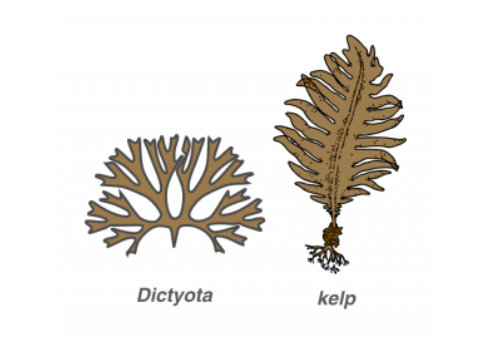
We have been developing Dictyota dichotoma as a model system for cell polarity and embryogenesis in brown algae since 2009, as a complement to the classical Fucus zygote, where work has always depended on gametes gathered from field populations during the reproductive season. Dictyota is a genus of flattened brown seaweeds with dichotomously branching apical meristems found along temperate and tropical coasts, whose reproduction follows a lunar rhythm, making it as interesting for chronobiology as it is for developmental biology.
Its phylogenetic position within the Dictyophycidae, its oogamous reproduction and freely developing zygotes, and full control of its life cycle in the laboratory within two to three months make it a powerful system for asking how a single cell breaks symmetry and commits to an apical or basal fate. Light governs both the timing of gamete release and the direction of the first developmental axis, placing photobiology at the centre of both questions. Our work on two-step polarisation and on auxin function in brown algae, together with the reverse genetics tools currently under development, is establishing it as an emerging model organism in which embryonic patterning can be directed, imaged, and dissected.
Meet Undaria
We are actively developing Undaria pinnatifida as a general laboratory model for kelp biology since 2019. Undaria is a large annual alariacean kelp native to the northwest Pacific, cultivated at scale as wakame and introduced across Europe, Australasia, and the Americas.
Kelps form the underwater forests of temperate rocky coasts and underpin the fastest-growing sector of marine aquaculture, yet few are tractable in the laboratory. Undaria combines a short annual cycle, easily maintainable gametophytes, and directly accessible fertilisation and embryogenesis, which makes it a powerful system for studying life cycle control, the regulation of fertility, and early development in the Laminariales. With our work on fertilisation, parthenogenesis and life cycle control and the development of efficient genome editing in this species we aim to establish this ecologically and economically important kelp as an experimental system and aim to give kelp cultivation the kind of tools that crop breeding.
Contact
Join the lab & collaborate with us
We welcome motivated students and collaborators interested in how seaweed decide their cell fate, how macroalgal multicellularity evolved, and what governs timing of growth and reproduction in the sea.
Email the labKenny Bogaert
Head
Marine Biological Station Carolinensiel
Integrative Cell Biology and Physiology
University of Münster
kenny.bogaert@uni-muenster.de (main)
kenny.bogaert@tuebingen.mpg.de
kenny.bogaert@ugent.be