
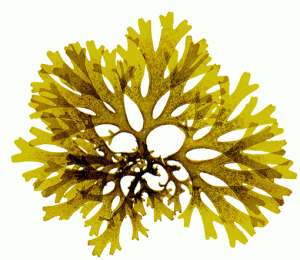
My research interests lie primarily in the chemical ecology, evolutionary devolopmental biology and ecophysiology of seaweeds. More specifically my main area of research lies in the differentiation of the attachment structures of seaweed propagules and the interaction with biotic and abiotic environment. Many research interests are fundamental – focussing on ecological interactions, asymmetric cell division and rhizoid differentiation – but also the applied aspects of seaweed propagule attachment on substrates for the emerging local seaweed aquaculture are of interest. My main focus is the propagules of Dictyotales, an important brown algal order in tropical ecosystems.
Cell differentiation and rhizoid development in seaweed propagules
Asymmetric cell division and cell differentiation.
Understanding the mechanisms of polarization and patterning of cells, tissues and organs is a central goal for developmental biologists. Embryos of angiosperms develop when they are still enclosed in the maternal tissue, which renders cellular, molecular and physiological analyses a technical challenge. In contrast, harvesting gametes from broadcast spawning seaweeds such as Fucus and Dictyota is easy and leads to large populations of synchronous developing cells. Moreover, the large size of the eggs makes visualization of the internal structures and experimental manipulation of the zygotes more easy.
The model species used most often belong to the genera Fucus and Silvetia. The difficulty of culturing these fucoid algae under laboratory conditions impedes extensive use of genetics, genomics and epigenomics in this line of developmental research. In contrast, the oogamous parenchymatous Dictyota dichotoma has been cultured for decades. Part of my research aims to get deeper insights in the polarization mechanisms and the evolvability of early development in plant systems using Dictyota as the model system.
Biotic and abiotic interaction regulating seaweed recruitment.
How the attachment of seaweed propagules can be regulated is a topic of interest. Past research has demonstrated that auxin acts as a rhizoid differentiation promoting compound. Here Dictyota is the model organisms of choice. However also commercially relevant species are looked at in the context of more applied projects.
Growth and sexual reproduction of seaweeds
Working with zygotes and spores laboratory strains of seaweeds, control over their growth and fertility is vital. Topics under study are temperature tolerance of Dictyota populations in response to increased temperatures in the context of global warming, the effect of lunar periodicity on fertility and life cycle aberrations of Dictyota.
A focus on algal and seaweed -omics
The application of omics is an important part of my work.
Genomics. I am involved in seaweed genome sequencing projects such as that of Ulva, Ostreobium, etc. Using comparative genomics I try to address questions related to auxin biology and the evolution of multicellularity in seaweeds. Nowadays brown algae are of special interest, because they are one of the only three eukaryotic lineages besides the Viridiplantae and animals which have independently evolved a complex parenchymatous multicellular growth mode.
Transcriptomics. A lot of my work encompasses transcriptomics on seaweeds or unicellular algae. Besides established methods, I apply scRNA-seq to seaweeds and surprisal analysis, an information-theoretical approach that applies thermodynamics to expression data delineating a balanced state and constraints explaining the variation in the data.
Metabolomics. At present, I am increasingly including (exo)metabolomics in order to explore the chemical ecology of early development of seaweed propagules.